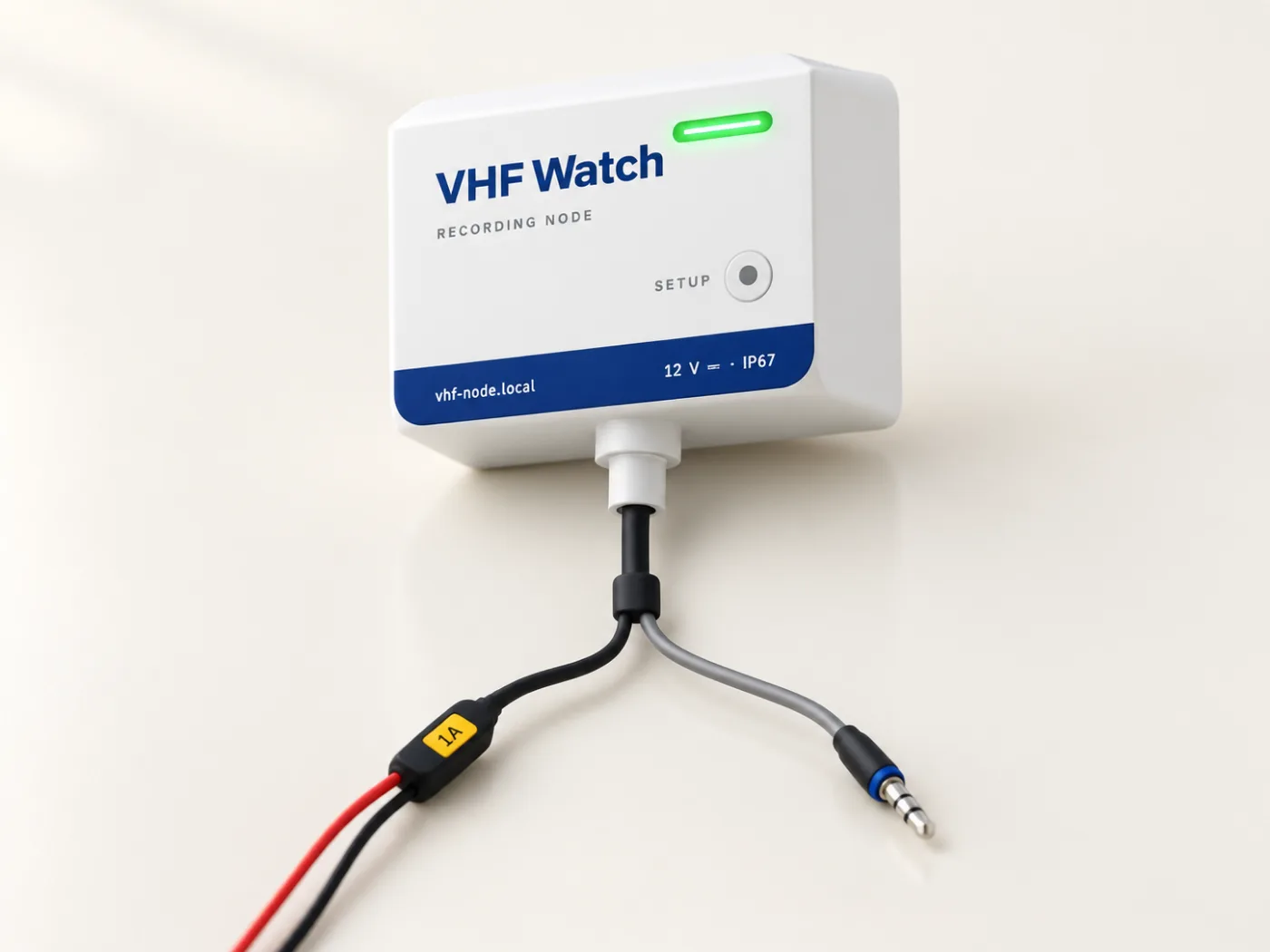
VHF Watch Recorder
Records every transmission from your VHF, with or without a phone aboard.
€109incl. VAT, plus shipping
Not on sale yet. The first batch is planned for spring 2027. Join the pre-order list and get 50% off when it goes on sale.
VHF recorder and free app
Below deck, kettle on, engine running. Somebody calls your boat on 16. VHF Watch records every transmission, writes it down on your phone with no internet, and tells you when a call was for your boat, or was a Mayday.
€109incl. VAT, plus shipping
−50%€54.50 for everyone on the pre-order list
The app is free
Join the pre-order listHow it works
Everyone on the list gets 50% off when it goes on sale. The app needs no subscription and no account.
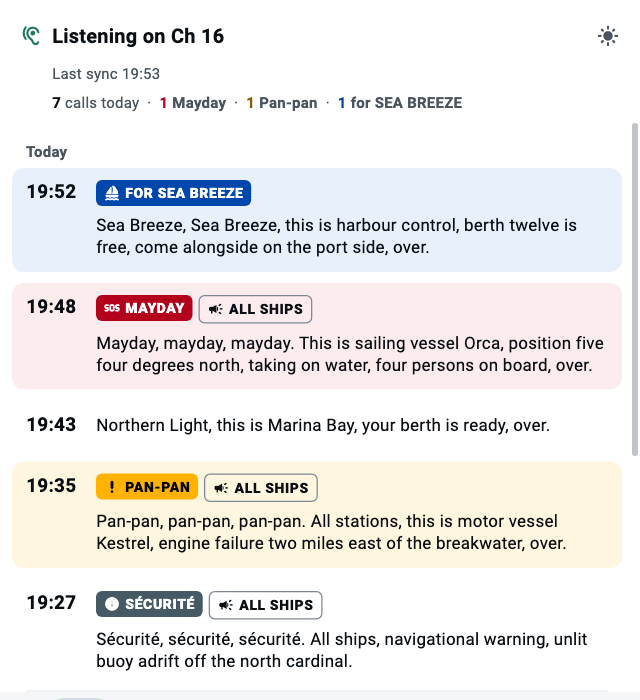
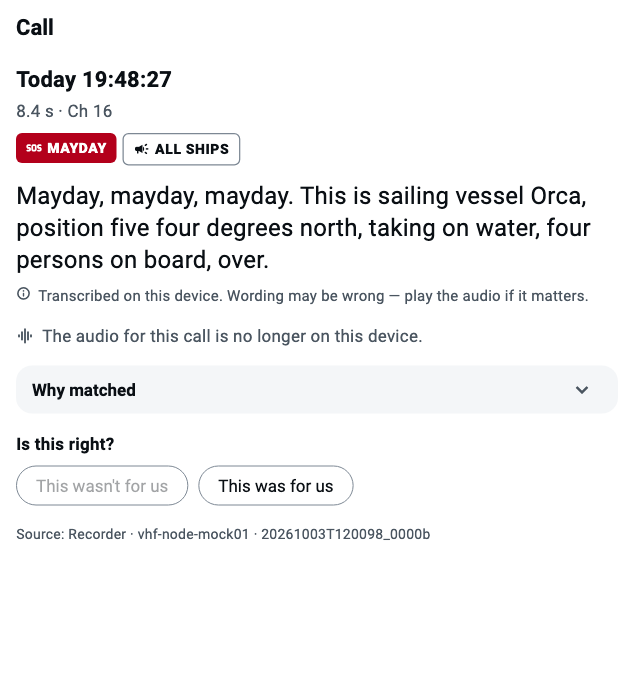
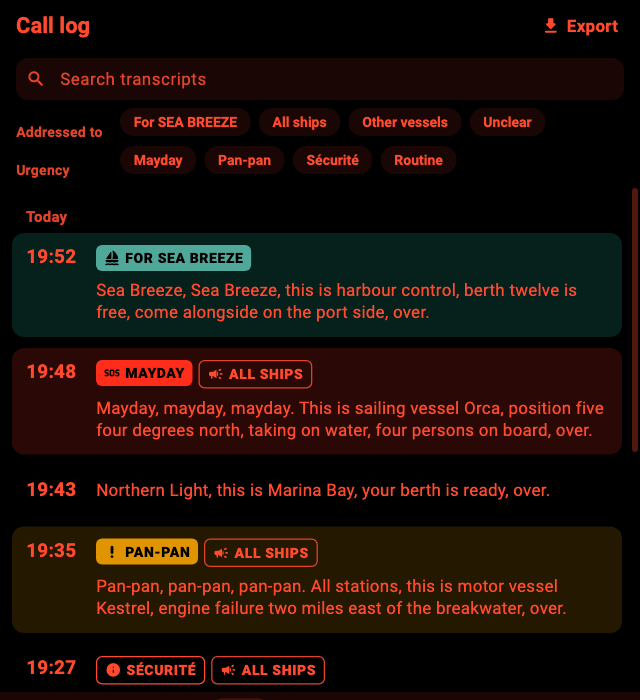
An example radio log with 7 made-up calls on channel 16. The call to SERENITY raises an alert.
You are meant to. On a boat with two people aboard, it does not happen. One of you is asleep, one is steering, the radio is at the chart table and the engine is louder than the speaker.
Most of what you miss does not matter. A friend wanting to meet in the next bay. The marina calling back about a berth. But every season somebody finds out afterwards that there was a Pan-pan two miles away, or that a boat had been calling theirs for twenty minutes.
VHF Watch does not keep your watch for you. It makes the hours when nobody is at the radio less blind.
One cable and an app. Nothing to open up inside the radio, no software to install on the recorder.
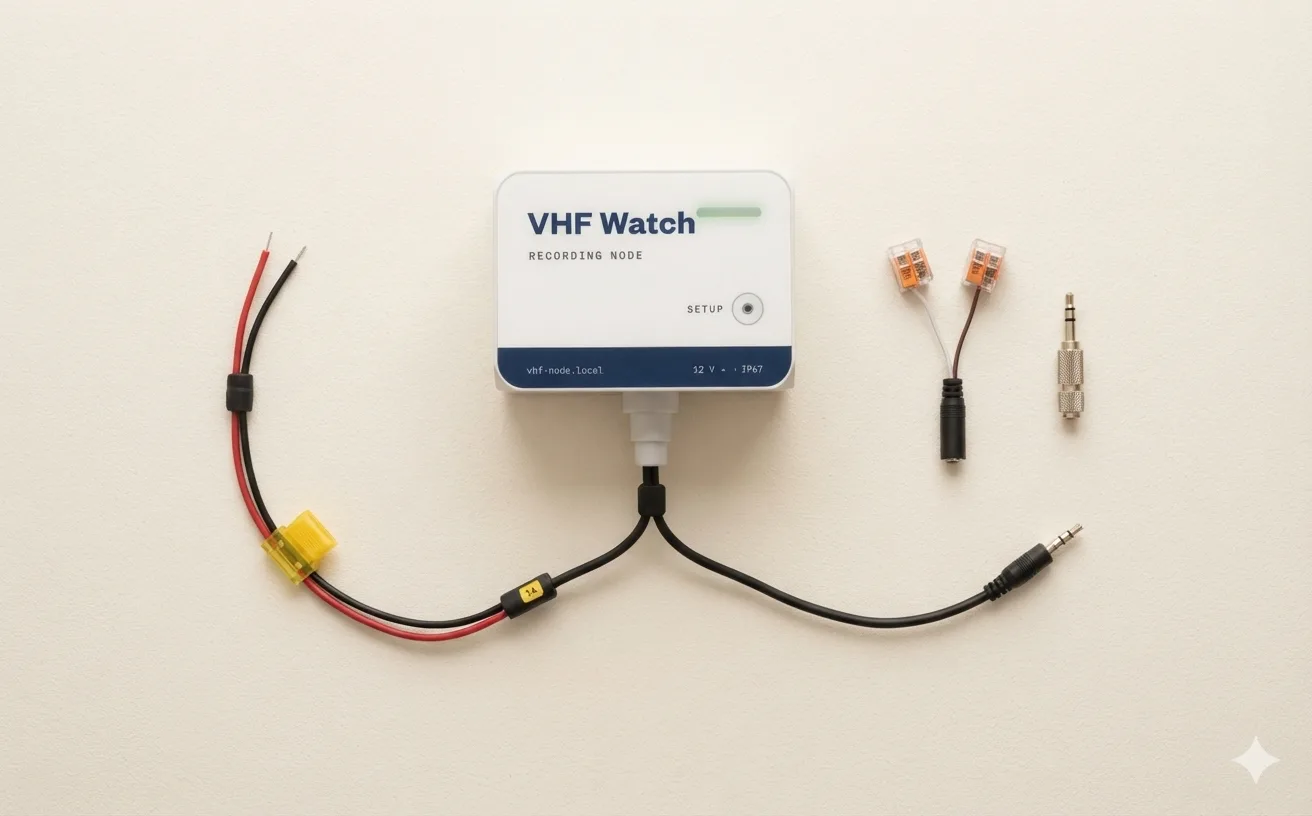
The recorder’s audio leg goes straight into a 3.5 mm headphone socket. Most fixed sets bring the external speaker out as bare wires instead: the speaker-wire adapter splices onto those with two lever connectors, no soldering. A 2.5 mm adapter covers smaller sockets. The recorder hears exactly what the radio plays.
Connect the fused lead to a 12 V or 24 V supply that is on whenever the radio is on. The recorder starts listening by itself, and its clock keeps time with the power off.
Use the recorder’s own WiFi network, or have it join the boat’s router or a phone hotspot. None of these needs the internet.
The app finds the recorder by itself. Enter your boat’s name, and you are watching. Whenever the app checks for calls, it collects what the recorder heard and writes it down.
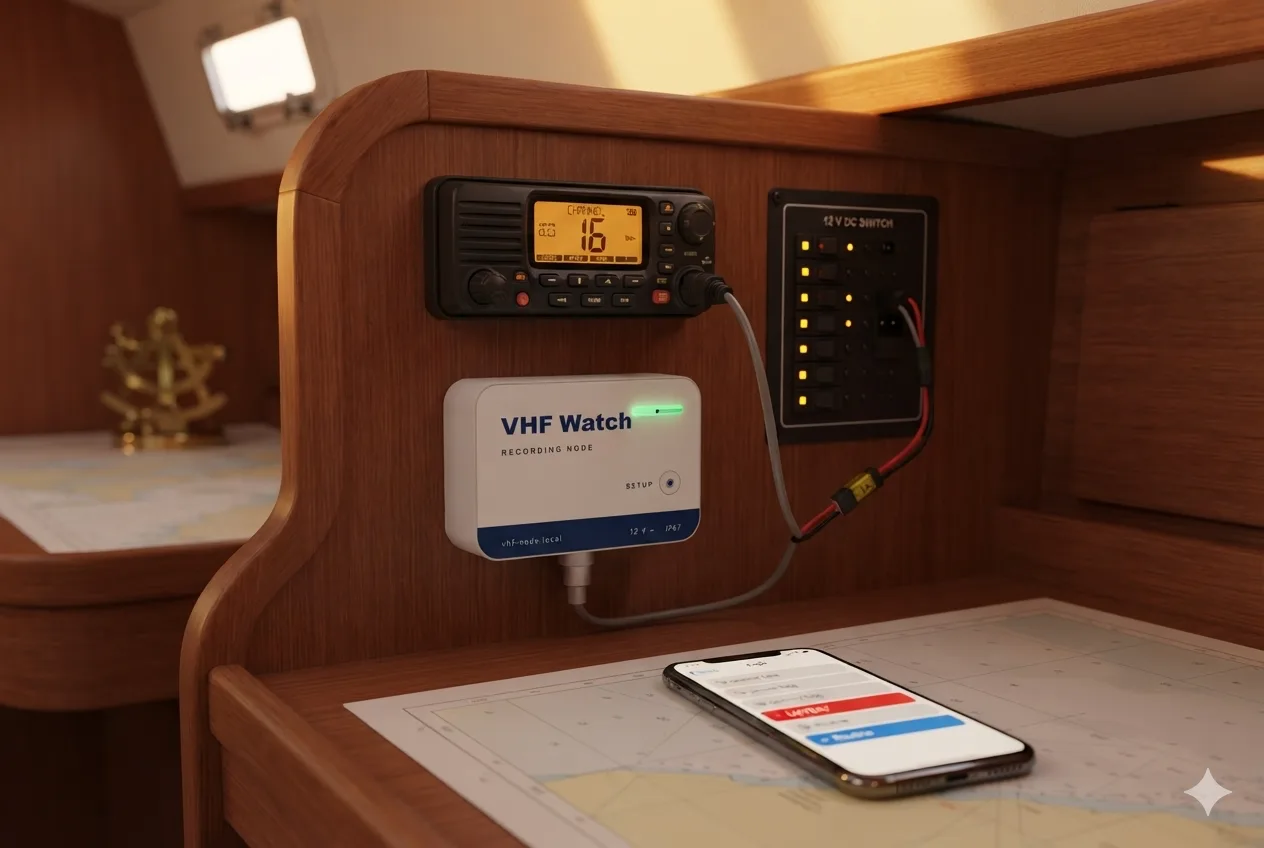
A recorder on the radio, an app on your phone or Mac. Nothing in between, and nothing on the internet.
The recorder writes each call to its own memory card, whether or not a phone is aboard. Silence is not recorded, so the 1 GB card holds about 30 hours of actual radio traffic.
The app turns each call into text on your phone or Mac. The speech engine is built into the app: no download, no cloud, no account, no signal needed.
An alert with sound for a possible distress call, a possible urgency call and a call for your boat. Sécurité and all-ships calls get a quiet notification. Other boats’ traffic is logged without a sound.
When the app is not sure whether a call was for your boat, it says it was. On Mayday, Pan-pan and your boat’s name it prefers a false alarm to a missed call. It tells you why it flagged each call, so a false alarm takes a second to dismiss.
Radio voices mangle names. If “Serenity” arrives as “Sir Enity”, it still alerts, and you can add that as a spelling of your boat’s name so it is recognised from then on.
Back from ashore or awake after your off-watch: one line tells you how many calls came in, how many were Mayday or Pan-pan, and whether any were for your boat.
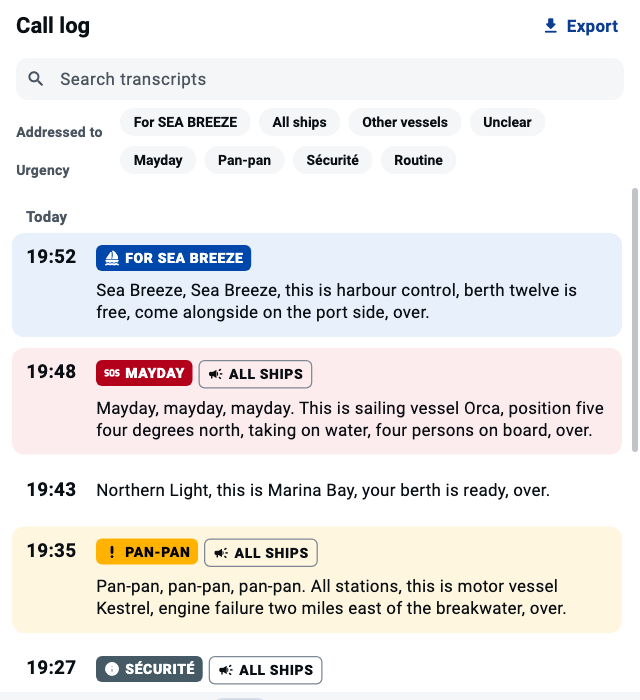
Every call with its time, channel, transcript and the original audio. Search it, filter it, and play any call back to hear it for yourself.
Three themes, one tap apart. Night keeps your night vision. Alerts always show at full strength.
The recorder joins the boat’s WiFi or a phone hotspot, or runs its own network. The app finds it by itself. No internet anywhere.
The app is free for iPhone, Android and Mac, with Windows to follow. Several devices can watch the same recorder. A laptop that stays aboard makes the steadiest watch.
One thing to buy, and it is the recorder. The app is free on every platform, with no subscription.
Records every transmission from your VHF, with or without a phone aboard.
€109incl. VAT, plus shipping
Not on sale yet. The first batch is planned for spring 2027. Join the pre-order list and get 50% off when it goes on sale.
| Audio input | Transformer-isolated, from the radio’s external-speaker wires, headphone socket or line-out |
|---|---|
| Recording | 16 kHz mono, only while a transmission is heard |
| Storage | 1 GB memory card, about 30 hours of actual radio traffic |
| Clock | Battery-backed, set from the app |
| Wireless | WiFi 2.4 GHz: its own network, the boat’s router or a phone hotspot |
| Power | 12 V or 24 V DC boat systems, about 120 mA at 12 V (estimate) |
| Size | 66 × 46 × 24 mm, white shell with a navy band, sealed to IP67 |
| Internet | Never needed, never used |
One app for iPhone, Android, Mac and Windows. No account, no subscription, no adverts, nothing sent to us. It is not in the app stores yet: it will be there before the first recorders ship.
Runs on our test iPhones. App Store submission still to come.
FreeComing soon
Built and tested on the Android emulator. Google Play still to come.
FreeComing soon
Runs on our Macs today. Download here when the first batch ships.
FreeComing soon
Written but not yet tested on Windows. We will not release it until it is.
FreeComing soon
It is an aid to your watch, not a replacement for it. Your obligations under the COLREGs and the GMDSS stay yours. Keep the radio on and keep listening.
It is not type-approved marine equipment and it does not decode DSC. Your radio’s DSC alarm is your radio’s job.
Radio audio is noisy and the writing-down is done by a machine. Words will be wrong, sometimes the label too. Every call keeps its audio: if it matters, play it.
By design. On Mayday, Pan-pan and your boat’s name it would rather be wrong than silent. That is why the alerts say “possible”.
A very weak call can stay under the noise filter. If the radio’s volume is turned right down, the recorder hears nothing. If the memory card fills with calls no device has collected, the recorder stops rather than delete them.
The app writes a call down once it has collected it, usually seconds after it ends. On iPhone, if you force-close the app, alerts stop until you open it again. The recorder keeps recording and you see the missed calls on reopen.
It works on the bench, with a real recorder and real phones, on recorded calls. The sea trial is next, and we will publish what we find. The recorder is not CE-marked yet, and it will not ship until it is.
Listening to VHF is allowed everywhere. Recording it, keeping it and passing it on are restricted in some countries. Check what applies where you sail.
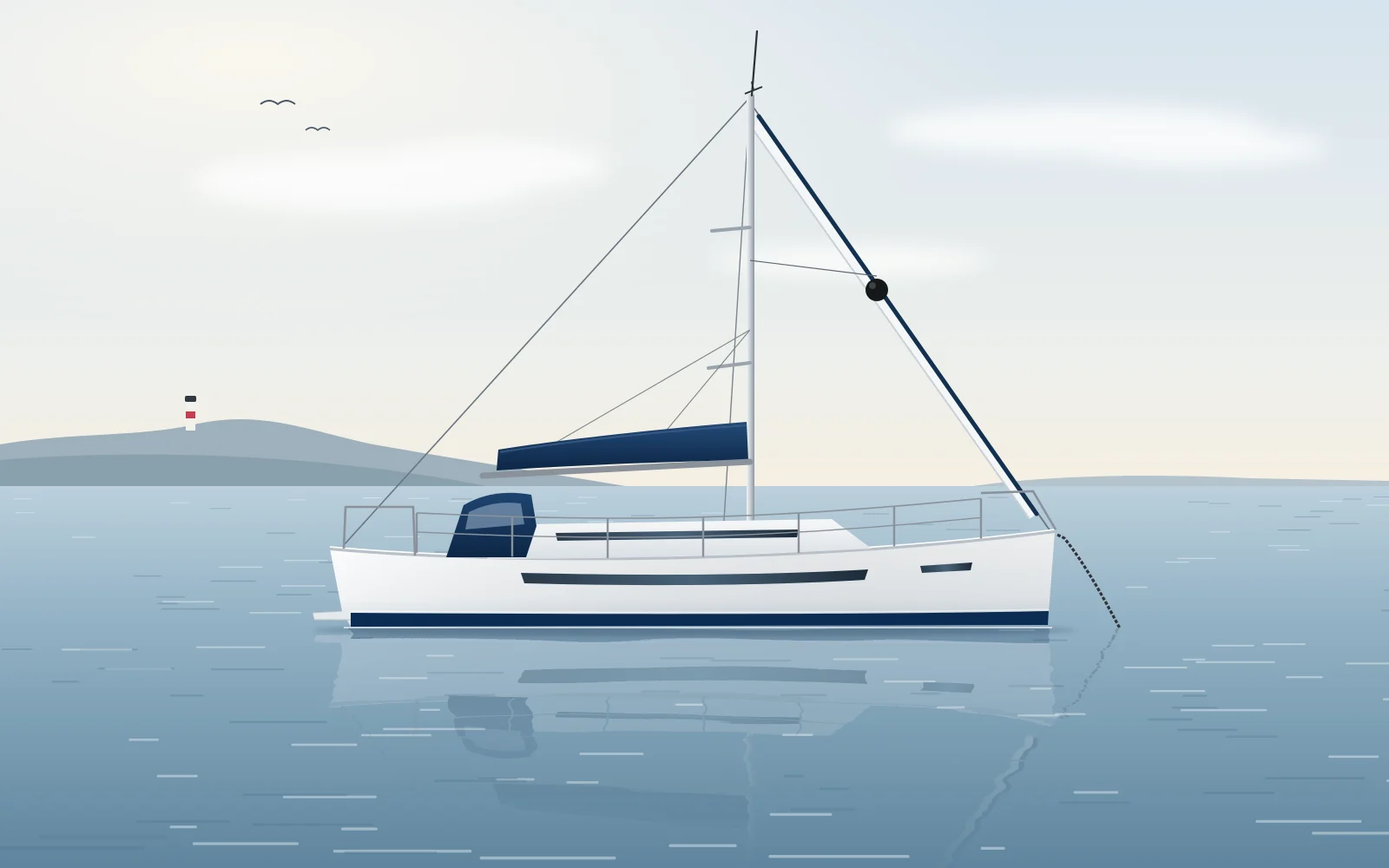
We are Leo and Lukas, and for a long stretch our Bénéteau Océanis 350 was not a hobby but our home: we lived aboard and sailed her more than 5,000 miles. VHF Watch is the thing we wanted aboard all that time: a recorder that keeps every call, and an app that only interrupts you when it matters.
When you live aboard, the VHF is on all day, and nearly everything on it is for somebody else: fishing boats, marinas, two yachts arranging dinner. You stop really listening. And then the call that matters comes anyway. The marina calls back about your berth while you are at the mast. Friends call you on 16 while the engine is running. A Pan-pan goes out, you catch only the last few words, and you spend the next ten minutes wondering what you missed.
Every time it was the same thought: the radio heard all of it. It just could not tell us afterwards. With two people aboard, one is asleep, one is steering, and the radio sits below at the chart table.
So we built the thing we wanted aboard: a small recorder behind the radio that keeps every call, and an app that writes them down and only interrupts you when it matters. It needs no internet, because at sea there usually isn’t any. Our Océanis is the boat it is designed around. So far it has been tested on the bench with recorded VHF calls; the sea trial aboard comes before the first batch ships.
VHF Watch is made by Leo Praschl, Lukas Greul and Raphael Schaumburg-Lippe.
Questions, or a radio you are not sure about? Write to office@pragre.com. One of us answers.
With any fixed VHF that has external-speaker wires, a headphone socket or a line-out, which is nearly all of them. Most fixed marine sets bring the external speaker out as two bare wires at the back: the supplied lead splices onto those. For a 3.5 mm or 2.5 mm socket there are adapters in the box. On some radios, plugging into the headphone socket mutes the radio’s own speaker, so the speaker wires are the better choice there. Handheld radios have not been tested.
Two connections. The recorder has one cable that splits in two. The audio leg plugs into the radio’s headphone socket, or onto its external-speaker wires through the lever-connector adapter, and the 1 m 12/24 V leg with its inline fuse goes to a supply that is on with the radio. The audio input is transformer-isolated, so it is also safe on radios whose speaker output is bridged, where neither wire is earth. Line-out is best where you have it, because it does not depend on the volume knob.
It runs on 12 V and 24 V boat systems. We estimate about 120 mA at 12 V, roughly 3 Ah a day (about half that current on 24 V). That is an estimate from the parts, not a measurement of the finished recorder, and we will publish the measured figure before it ships.
No, never. The recorder and the app talk over the boat’s own WiFi, a phone hotspot or the recorder’s own network. The speech engine is inside the app, so nothing is downloaded and nothing is uploaded.
Yes, while the app is running in the background it keeps collecting calls and alerting. If you force-close it, iPhone runs no code until you open it again: no alerts in that time. The recorder keeps recording, and the app shows what you missed when you reopen it. Do Not Disturb and Focus can silence alerts on iPhone, so allow VHF Watch in your Focus settings. On Android the watch keeps running in the background (some phones’ battery savers need telling to leave it alone), and its alert tone sounds through Do Not Disturb unless alarms themselves are silenced.
The recorder only records while someone is transmitting. The 1 GB card holds about 30 hours of actual radio traffic. Most of a day on Channel 16 is silence, so that is usually several weeks of calls. Once your app has collected calls, the recorder reuses that space when the card gets full. Calls no device has collected yet are never deleted.
Yes. Any number of phones, tablets and computers can watch the same recorder. One device clears the recorder’s card as it collects calls; the others watch along. The app asks which is which when you set it up.
It gets words wrong, more often on weak or clipped calls, and boat names are the hardest part. We have measured it on recorded calls, not yet at sea, so we are not quoting accuracy figures until the sea trial is done. What it is built to do is not to miss Mayday, Pan-pan or your boat’s name, even at the cost of some false alarms. Every call keeps its audio so you can listen for yourself.
It is built for English radio procedure. Mayday, Pan-pan and Sécurité are the same in every language. You can set the spoken language to English, Italian, German or automatic; Italian and German calls are in our test set, other languages have not been tested.
Listening is allowed everywhere. Recording other people’s radio traffic, keeping it and passing it on are restricted in some countries, and the rules depend on the waters you are in, not only where you live. Check what applies where you sail. The app tells you this when you set it up, keeps everything on your own devices, and lets you set how long recordings are kept.
No. It is an aid to it. It is not certified safety equipment, it does not decode DSC, and it can be wrong. Keep your radio on and keep listening.
Join the pre-order list with your email address and confirm it. When the recorder goes on sale, we send you a code for half price on one recorder. You enter it on the payment page. Joining costs nothing and commits you to nothing.
The first batch is planned for spring 2027. Before it ships, the recorder needs its CE marking and a sea trial, and the apps need to be in the App Store and Google Play. If the date moves, we email everyone on the pre-order list, with the reason.
Austria and Germany €6.90, the rest of the EU €11.90, Switzerland, Norway and the UK €17.90. Outside the EU, import VAT and a carrier fee may be due on delivery. Details on the shipping page.
You have 14 days from delivery to send it back for a full refund, see right of withdrawal. A pre-order can be cancelled any time before it ships. If it is faulty, the 2-year statutory warranty applies: email us and we repair or replace it.